Menu

  • Home
  • About
  • Search
  • Featured Shows
Spokely

© 2026 Spokely

Business History

Business History

Pushkin Industries

BusinessHistory

It’s the history of business. How did Hitler’s favorite car become synonymous with hippies? What got Thomas Edison tangled up with the electric chair? Did someone murder the guy who invented the movies? Former Planet Money hosts Jacob Goldstein and Robert Smith examine the surprising stories of businesses big and small and find out what you can learn from those who founded them.

Episodes

How GM Beat Ford

How GM Beat Ford

Ford was the pre-eminent American car maker and Henry Ford was the king of modern manufacturing, until a Michigan cigar salesman decided to consolidate a bunch of small auto companies into a single firm to defeat the Colossus of Detroit. General Motors united the likes of Oldsmobile, Buick, Cadillac and decided to live by "the laws of Paris dressmakers" to make cars that were more stylish and fashionable than the austere, black-painted Model T that was coming out of the Ford plant. Write to us at businesshistory@pushkin.fm See omnystudio.com/listener for privacy information.
36min•Mar 11, 2026
Henry Ford Invented the Modern World... Then Got Left Behind

Henry Ford Invented the Modern World... Then Got Left Behind

Farm boy Henry Ford hated toil. If only someone could invent ways to work more efficiently, as well as cheap, reliable machines to take some of the strain. Ford was a tinkerer and a lover of the newly invented automobile - so he started building cars in a new, streamlined way that made them affordable to many more Americans. Thanks to Ford’s production line techniques, the Model T became the biggest selling car in the world. And other factories copied his system to manufacture the radios and vacuum cleaners that kickstarted the modern boom in consumerism. But then Henry Ford stopped listening to what car buyers wanted. See omnystudio.com/listener for privacy information.
49min•Mar 4, 2026
War, Exploration and Beer: How the Tin Can Changed the World

War, Exploration and Beer: How the Tin Can Changed the World

Old-fashioned ways of preserving food made for salty, vinegary or chewy meals - but it was often a choice between that or starving. Soldiers, explorers and ordinary people alike faced malnutrition and food poisoning - but then came a French revolution... in a can! First invented in Napoleonic France, the humble can would feed armies; sustain bold exploration; and give poor people access to wholesome food all year round. We don't think about the tin can much today, but its history is filled with skullduggery, vast riches and deadly choking hazards. See omnystudio.com/listener for privacy information.
56min•Feb 25, 2026
The War on The A&P: When America Decided Cheap Groceries Were "Evil"

The War on The A&P: When America Decided Cheap Groceries Were "Evil"

Mom and Pops grocery stores were charming, but inefficient. They contributed to Americans either spending a lot on their food or having to go hungry. The Great Atlantic and Pacific Tea Company changed the entire model. The A&P established a chain of stores selling branded goods at the lowest prices. The A&P kept its profit margins slim and allowed Americans to buy more food for less - but this wasn't celebrated as a success story. Politicians, radio stars and vested interests ganged together to hound The A&P. They demanded the grocery chain change its strategy, raise prices and even put its owners on trial on criminal charges. So why didn't America like cheap groceries? See omnystudio.com/listener for privacy information.
48min•Feb 18, 2026
 How To Dig a Train Tunnel Under the Hudson River (from HISTORY This Week)

How To Dig a Train Tunnel Under the Hudson River (from HISTORY This Week)

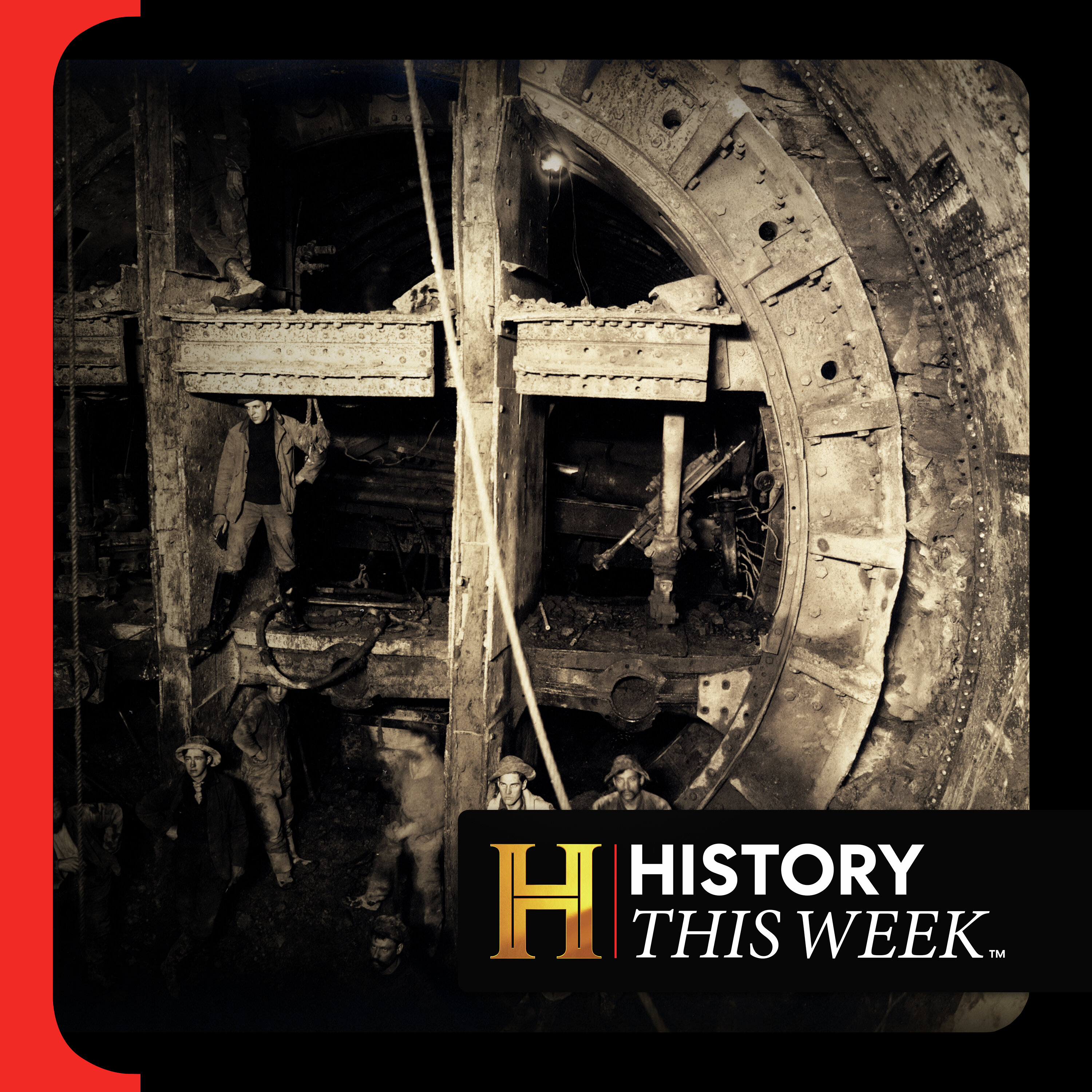
For more historical deep dives just like these, check out HISTORY This Week wherever you get your podcasts! February 14, 1905. A stick of dynamite detonates under the Hudson River — and the ground above swallows a locomotive whole. It's the latest setback in an audacious plan to tunnel beneath the river and bring trains into Manhattan. The Pennsylvania Railroad is the largest corporation in the world, but the goopy riverbed keeps fighting back. How did they finally break through? And why are these 115-year-old tunnels still the most critical infrastructure in America? Special thanks to our guests: Polly Desjarlais, content and research manager at the New York Transit Museum; Jill Jonnes, author of Conquering Gotham: A Gilded Age Epic: The Construction of Penn Station and Its Tunnels; and Andy Sparberg, former LIRR manager, transit historian, and author of From a Nickel to a Token: The Journey from Board of Transportation to MTA.
34min•Feb 16, 2026
When E.T. the Extra-Terrestrial Tanked Atari

When E.T. the Extra-Terrestrial Tanked Atari

Nolan Bushnell loved weed, hot tubs and games... especially games. He took computer games out of the laboratory and put them in bars. His arcade game Pong was a monster hit, so he set up Atari to build a home games console which became the must-have Christmas present of 1975. Atari was the name on every kid's lips... but then investors came onboard to help the company expand. Bushnell and his engineers were sidelined, and Atari embarked on a crazy plan to rush out a game based on Spielberg's movie E.T. the Extra-Terrestrial. It was so bad... it sank Atari.
49min•Feb 11, 2026
How a Bad Boss Kickstarted Silicon Valley

How a Bad Boss Kickstarted Silicon Valley

William Shockley was an electronics genius - he even won a Nobel Prize - but he was an awful boss. Shockley was a cruel, paranoid micromanager. And this annoyed the staff of brilliant young engineers he'd assembled in a quiet town in Northern California. In fact, they quit and set up a company of their own inventing silicon chips. Robert Noyce, Gordon Moore and the rest of "The Traitorous Eight" transformed computing, but also blazed a trail for the tech founders who would flock to Silicon Valley and change the world. Members of "The Traitorous Eight" set up Intel and AMD, while also funding businesses such as Google and Slack. See omnystudio.com/listener for privacy information.
47min•Feb 4, 2026
Sears: Cocaine Wine, Shotguns, and the World’s Tallest Tower

Sears: Cocaine Wine, Shotguns, and the World’s Tallest Tower

Richard Warren Sears started off selling pocket watches - then published a catalog full of hundreds and hundreds of products from shotguns to cocaine wine. Sears & Roebuck offered even Americans living on remote farms the chance to shop like city dwellers. The catalog became an American institution - the Amazon of the 1890s - but as the nation changed, Sears adapted too and built a vast chain of physical stores. Sears felt so secure that it built the world's tallest office building to house all its staff - but then came competition from specialist big-box stores and out-of-town megastores. Sears found itself in a death spiral and couldn't pull out.
43min•Jan 28, 2026
De-Nazifying the Love Bug: The VW Beetle Story Part II

De-Nazifying the Love Bug: The VW Beetle Story Part II

It's 1945. The Volkswagen factory has been bombed and members of the staff have been arrested as war criminals. So how did the company turn around in just a few years and begin making Beetle cars that became a global sensation? Big political and economic moves helped - but a British Army officer, Walt Disney and a New York ad agency also played pivotal roles in turning a car that Hitler had championed into the favourite ride of surfers, school teachers and hippies. See omnystudio.com/listener for privacy information.
42min•Jan 21, 2026
Hitler's Gift to the Hippies: The VW Beetle Story Part I

Hitler's Gift to the Hippies: The VW Beetle Story Part I

The VW Beetle was the biggest selling car of all time - and it found particular favor with people like hippies and surfers. But this icon of the 60s counterculture had its roots in Nazism. The Volkswagen - the People's Car - was an obsession of Adolf Hitler. He wanted to transform Germany into a land of drivers - and needed an affordable, but reliable automobile. Germany's private auto manufacturers knew the project was doomed to failure. So Hitler assembled a team of designers and factory managers to enact his vision - even if that meant enslaving workers and committing murder. See omnystudio.com/listener for privacy information.
33min•Jan 14, 2026
How Jim Simons Built a Machine That Beat the Market

How Jim Simons Built a Machine That Beat the Market

Jim Simons loved cigarettes and math. He started out as an academic mathematician and a Cold War code breaker - but decided to use his skills to write computer programs to spot investment opportunities in the financial markets. Simons and his fierce nerds bought up all the data sets they could find - reports, books, magnetic tapes - and built machine learning algorithms to hunt for tiny market discrepancies they could exploit. The investment funds Simons started made extraordinary profits - so is this the end for human emotions in financial trading?
43min•Jan 7, 2026
Old Warren Buffett: "Never Invest in a Business You Cannot Understand"

Old Warren Buffett: "Never Invest in a Business You Cannot Understand"

Young Warren Buffett became rich in anonymity - but in the 1980s he became a global star. During the excesses of 1980s Wall Street the middle-aged investor was reluctantly drawn into the spotlight to save troubled companies. And then came tech - which suited Buffett's style even less. Warren Buffett couldn't even use a computer - but everyone was telling him to buy tech stocks. How did Buffett navigate the dot com bubble when he'd never surfed the internet? And what will his company Berkshire Hathaway do in the era of AI as Buffett steps away? See omnystudio.com/listener for privacy information.
40min•Dec 24, 2025
Young Warren Buffett: How to Find Value No One Else Can See

Young Warren Buffett: How to Find Value No One Else Can See

Warren Buffett rose from obscurity to become the richest person in the world - and he did it in a unique way. As a boy in Omaha he collected information obsessively - writing down car license numbers and hoarding bottle caps. As a young man, Buffett turned his focus on scouring business accounts to find companies that had hidden value no one else could spot. We tell the story of young Warren Buffett as he quietly worked building up the expertise and accumulating the wealth that would allow him to become the most famous investor of our age. See omnystudio.com/listener for privacy information.
43min•Dec 17, 2025
How to Make Billions When the Bubble Bursts: Lessons from 1929

How to Make Billions When the Bubble Bursts: Lessons from 1929

The stock market was once a Wild West free-for-all. There were few rules or regulations. Investors were more or less gambling, or manipulating stocks to make a profit. This is the world Jesse Livermore came to dominate. He would often bet against the market, making money when businesses failed. By 1929, Livermore was rich and famous. And then the Wall Street stock bubble burst. Share prices went through the floor, fortunes disappeared, and lives were ruined. Many blamed Livermore, some even sent him death threats. But what of Livermore's fortune? Did he make the right calls during the Wall Street Crash? See omnystudio.com/listener for privacy information.
47min•Dec 10, 2025
The Man who Sued Major League Baseball (Rather than go to Philly)

The Man who Sued Major League Baseball (Rather than go to Philly)

Curt Flood was the best center fielder in baseball and one of the game's highest payed players. He helped the St Louis Cardinals reach the 1968 World Series... but then got traded. The rules said he had no say in the decision. He either could go to Philly, or quit the sport. So Curt decided to sue. Curt argued that Major League Baseball should act like any other business and let workers sell their labor to whichever team they liked. But for decades, courts had ruled in favor of the team owners. Curt’s fight would destroy his career; anger many parts of American society; and change sports forever.
51min•Dec 3, 2025
Edison and the Movie Murder Mystery  (The Edison Story Part 3)

Edison and the Movie Murder Mystery (The Edison Story Part 3)

The man who invented the movie camera got on a train in France in 1890 and was never seen again. The wife of Louis Le Prince thought she knew who’d ordered her husband’s disappearance and presumed murder - Thomas Alva Edison. Many people were simultaneously racing to develop moving pictures - so had Edison decided to bump off his closest rival so he could win? The story of who deserves the credit for the movies is a murky one - involving bitter betrayal, courtroom drama and soft-core porn.
53min•Nov 26, 2025
Edison, Tesla and the Electric Chair  (The Edison Story Part 2)

Edison, Tesla and the Electric Chair (The Edison Story Part 2)

Thomas Edison didn’t invent the lightbulb, but he created something more important: the grid. Edison's system of power plants and wires brought lightbulbs to homes and offices and revolutionized modern life. Edison was adamant that direct current (DC) should power America, and attacked competitors who said that alternating current (AC) was better. This sparked a bitter war between Edison and his rivals - and prompted Edison to become involved in the first case of a murderer being sent to the electric chair. See omnystudio.com/listener for privacy information.
46min•Nov 19, 2025
The Edison Invention People Don't Talk About (The Edison Story Part 1)

The Edison Invention People Don't Talk About (The Edison Story Part 1)

Thomas Alva Edison helped transform America and the world. He registered over one thousand patents before he died in 1931 - and we can thank him for advances in electric power, communications technology, music recording and even the movies. But his biggest breakthrough doesn't get nearly enough attention. In many ways, Edison invented modern inventing.
49min•Nov 12, 2025
The Secret of Southwest's Success: Free Whisky, Hot Pants and Low, Low Fares

The Secret of Southwest's Success: Free Whisky, Hot Pants and Low, Low Fares

It's hard to make money running an airline - but Southwest was profitable every year for nearly five decades. How did it manage it? Business History hosts Jacob Goldstein and Robert Smith explore how a carrier with just four airplanes shuttling across Texas revolutionized flying by offering free whisky, cheap late-night tickets and free-for-all seating allocation. Southwest developed a winning formula that forced its competitors to change how they did business - but then the Southwest model fell apart. Find out why. Key books: Hard Landing by Thomas Petzinger Jr; Nuts by Kevin and Jackie Frieberg Other sources: The Theory of Economic Regulation by George Stigler; Fortune Magazine: The Rapid Descent of Southwest Airlines; Southwest Airlines: When Herb Met Rollin.
52min•Nov 5, 2025
Coming Soon: Business History with Robert Smith and Jacob Goldstein

Coming Soon: Business History with Robert Smith and Jacob Goldstein

Was the world's most lovable car originally made just to please Hitler? And what links Thomas Edison and the electric chair? From Jacob Goldstein and Robert Smith of Planet Money fame comes Business History, a new show uncovering amazing stories from the history of business. From sandals to suits, Business History brings to life the greatest innovations, the boldest entrepreneurs and the craziest mavericks in the annals of commerce and finance. We’ll explain why some company stocks soar, while other business ideas crash, and share the valuable lessons.
2min•Oct 29, 2025
1 / 1